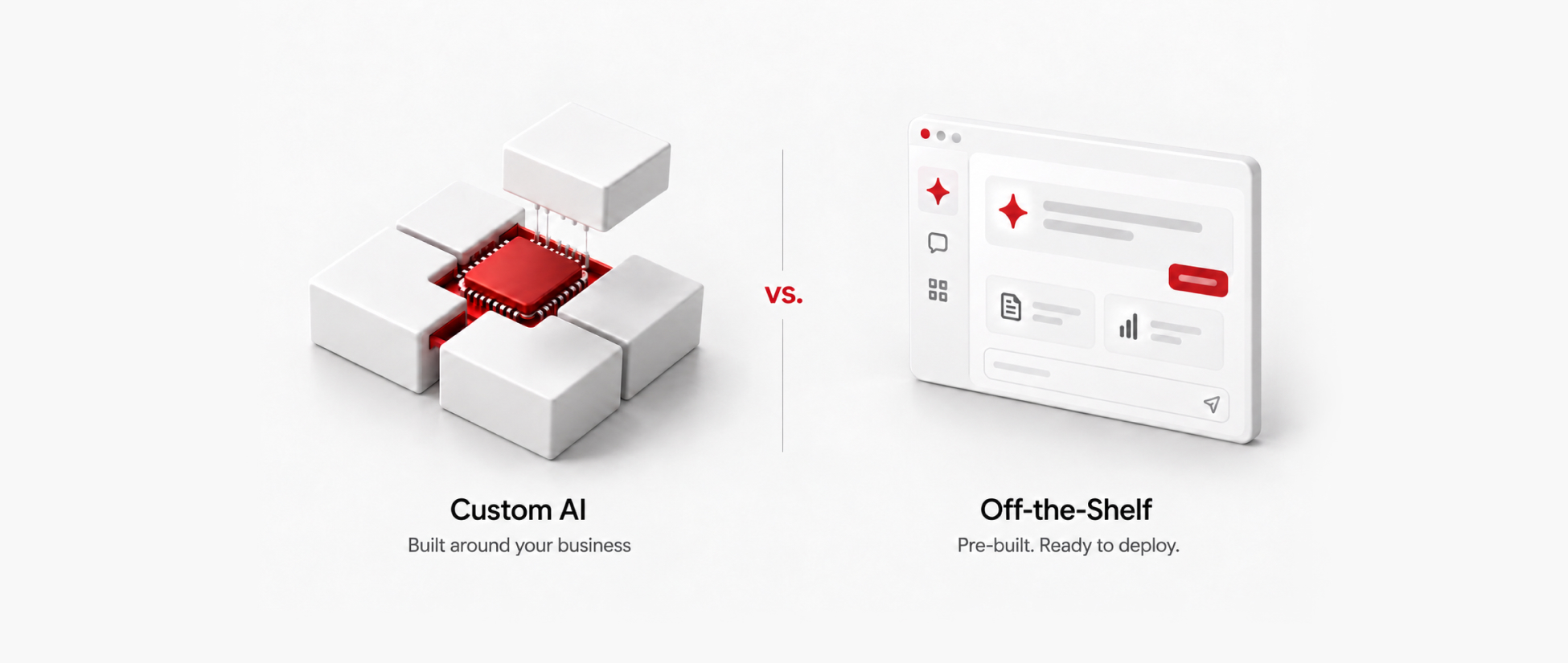
The Executive’s Dilemma: Custom AI vs. Off-the-Shelf Solutions
For most enterprises, AI used to sit snugly within the innovation budget, where it was easy to fund and easy to cut. However, now, AI plays an integral role in customer service, workforce staffing, finance, operations, and product development. It plays a vital role in corporate strategy, with costs, risks, and profits that multiply yearly.
Over time, we are seeing a new trend emerge in the software industry: a need for AI integration. There are two basic pathways to AI integration: customizing and building a personalized AI use case or buying a suitable one from a vendor. The former is particularly encouraged if your data assets are unique and you wish to keep your proprietary data secure, whilst the latter is preferable if you’re opting for a faster solution with lower costs and risks.
According to Menlo Ventures, in 2024, 47% of AI use cases were being customized and built, compared to 53% being purchased. There was a steep rise in these statistics in just a year because in December of 2025, it was reported that a staggering 76% of AI use cases were now being purchased and only 24% were being built from scratch.
This blog explains the difference between the Build vs. Buy dilemma, explaining how to tell them apart and what each path costs in money, speed, and control.
Operating Costs
Custom AI is mainly a capital decision, and off-the-shelf AI is mainly an operating one.
Custom AI is mainly a capital decision, and off-the-shelf AI is mainly an operating one.
What Does a Custom Build Cost?
A custom system is heavy in its spending. Your company has to pay for machine learning, data, and platform engineers before anything reaches production. You pay for the compute to fine-tune and evaluate models, and for several rounds of R&D, because the first version rarely meets the accuracy and standards that the business needs. The payments don’t stop after the first build; there is always post-launch hosting, monitoring, and periodic retraining to consider.
SmartDev puts modest custom build costs at $60,000 to $250,000.
However, a positive to consider is that this expenditure builds an asset that the company owns and isn’t shared with any other vendor, nor are its basic layouts known to your competitors.
What Does an Off-the-Shelf Solution Cost?
Packaged AI products are priced per seat or by usage, typically per token or per transaction. Entry is cheap, procurement usually runs through existing software channels, and finance can forecast the first year with some confidence. For a pilot or a department-level rollout, this is hard to beat.
Speed vs. Ownership: IP Ownership vs. Plug-and-Play Value
A buyable AI wins on time-to-value while customized AI wins on ownership.
The Speed Advantage
Many AI products can now be bought through the cloud marketplaces that enterprises already use, often under existing cloud agreements. Your team can have a working tool in days, show results within the coming quarter, and learn what the organization actually needs from the said tool before committing serious capital. Those early wins matter as they build confidence with the board and give teams hands-on experience.
The Proprietary Moat
If you opt to build, your parameters are often different and more specific than those who choose to buy. Proprietary data can be built upon and improved through customized systems and AI. This is an advantage for your company, as competitors will not be able to peek at your foundational systems as they would have if you shared vendors; nor would they be able to replicate or purchase your data. A competitor can license the same SaaS product you license. But they cannot license a model that you have created and trained on your claims history, your pricing decisions, or your customers’ behavior.
Ownership also keeps the learning loop inside the company. Each correction your experts make improves your system, and none of that improvement flows to a vendor’s general product, where your competitors would benefit from it too.
The Vendor Lock-In Trap
Renting a capability means the vendor sets its price, its roadmap, and its lifespan. Prices can rise at renewal. Models get deprecated, forcing rework on whatever you built around them. Features your teams rely on can disappear in a product update.
Corporate Governance: Privacy, Security, and Compliance
For governance, the deciding question is which data you are willing to let leave your boundary.
Data Sovereignty
Enterprise tiers of most major AI products nowadays exclude private customer data from training by default, but standard and consumer tiers can differ. Competitors who share the same vendors can have access to the same underlying technology
Regulations
A customized system deployed in your own private cloud or on-premises environment keeps that data inside boundaries you define. Auditors can trace where data went, who accessed it, and which model version produced a given output. That traceability is much easier to show when you own the full pipeline.
Evaluate Your Needs
Before choosing whether you want to build a customized AI use case or buy one off the shelf, there are certain factors for you to evaluate:
- Is AI a supportive function within your Enterprise, or is it your core capability?
- Are you willing to pay upwards of $60,000-$250,000 for a customized plan starting from scratch, or would you prefer to buy a pre-planned, mature AI use case that is already thriving in the market?
- Are you amenable to vendor lock-in and sharing your underlying tech with your competitors, or do you want a separate foundation, secure information, and tailored AI advantages?
A Hybrid Execution: Own the core, Rent the Commodity
The practical answer for most enterprises is a hybrid path: buy for the many workflows every company shares, and build for the few that define your market position.
Identifying the Commodity
Much of the AI that improves day-to-day productivity is the same everywhere. Drafting standard emails, summarizing meetings, routing basic internal IT tickets, answering HR policy questions, and translating documents all fall in this category. Building any of these yourself rarely creates an advantage, because the market already offers good, low-cost tools for them and those tools improve every few months without your investment.
For commodity workflows, the work is procurement and governance: choose a vendor, configure it, set data policies, and track usage so the cost stays visible.
Investing in the Core
Two projects from our own work show how investing in the core is beneficial. For an institutional investment firm, SSI built an intraday sentiment platform that ingests social media at scale, uses LLMs to score stock sentiment, and delivers daily trading signals. For a healthcare system, we built a workforce optimization platform that turns patient volume data into staffing schedules and cut scheduling time by 50%. Neither client could have bought those capabilities off a shelf, because the value came from their own data and decision logic.
Core builds also need a delivery model that does not take years. Our Smart Pods, hybrid teams of engineers working with AI across every phase, and our Momentum platform are designed to shorten the time from decision to a production system.
The Boardroom Mandate
Neither path is right for every capability. Companies that buy everything end up paying rising fees for tools their competitors also use, and companies that build everything spend scarce engineering talent on problems the market solved long ago. A deliberate mix, reviewed regularly, protects both margins and market position.
If your team is working through this classification, SSI’s AI services team can help you assess your portfolio and plan the builds that matter most.
