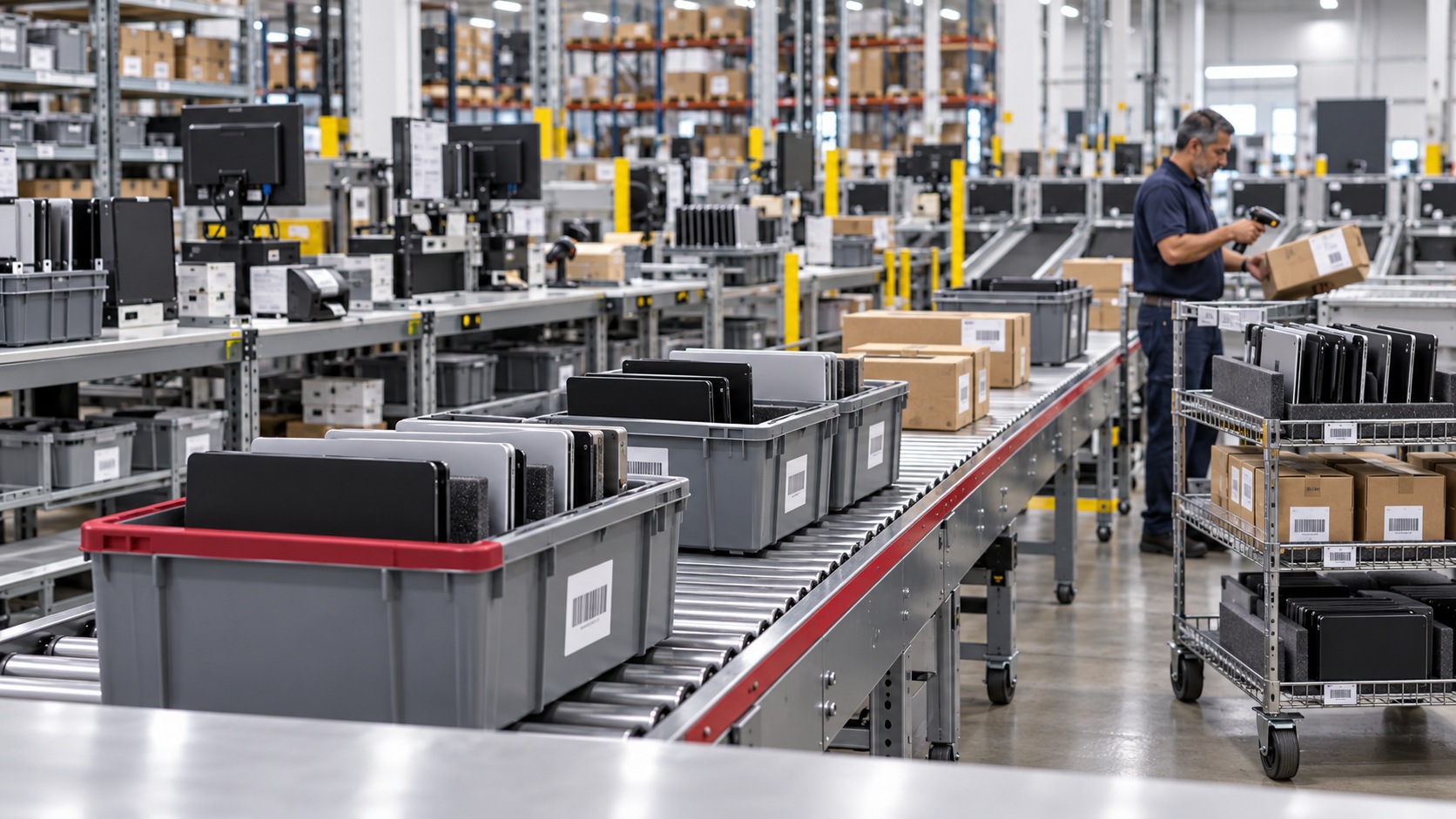
AI Powered Decision Intelligence Transformation for Reverse Logistics
Executive Summary
The global reverse logistics business volume is valued at hundreds of billions of dollars annually. Within this massive, high-velocity market, the client operates as a disruptive, AI-powered business, servicing large-scale enterprise clients.
For every returned item, complex variables need to be evaluated for determining the optimal return path that maximizes recoverable value.
SSI replaced a manual review workflow with a synchronized, multi-model AI system that classifies each asset’s condition, prices it against live market demand, evaluates all possible recovery paths and routes it to the highest value channel.
The system now prices and routes every return in 7 to 10 seconds at 85% ML accuracy, pricing seven condition grades independently and feeding live listings across five-plus retail channels, including eBay, Amazon and Backmarket b. The client is now able to recover fair market value, not leaving cash at the table. In addition, they can do this at machine speed and enterprise scale, without adding headcount as return volume grows.

CLIENT BACKGROUND
A Reverse Logistics Business Built on Volume
The client operates as a prominent national reverse logistics business, managing a continuous influx of returned electronics and decommissioned technology assets. Operating within a high-velocity global returns ecosystem that traps hundreds of billions of dollars annually, the business recovers capital by reselling these assets across diverse retail and wholesale channels, including eBay, PC Richard & Son, and Sam’s Club. Inventory arrives at their facilities in highly unpredictable quantities and widespread conditions, ranging from pristine, new electronics to heavily worn devices, alongside refurbished hardware categorized into strict A, B, and C condition grades. Each distinct grade carries vastly different secondary market values. Consequently, the client’s core operational hurdle was establishing an accurate, uniform method to instantly grade every device, price it against live market demand, and determine whether to sell it immediately, invest in structural refurbishment, or scrap it for parts.
THE BUSINESS PROBLEM
The High Cost of Manual Friction at Scale
In high-volume enterprise electronics returns, financial recovery depends entirely on two things: value capture (precision) and turnaround time (speed). Every returned device, from a massive data center server to a corporate laptop, loses value every day it sits in a warehouse.
When companies rely on manual human evaluation to process these assets, speed and precision suffer:
- Severe Warehouse Bottlenecks: Human reviewers cannot keep pace with heavy corporate return volumes, trapping working capital in stagnant inventory.
- Inconsistent Resale Pricing: Human bias causes massive margin loss. Underpriced items reduce profitability , while overpriced items sit on shelves unsold.
- Siloed Sustainability: Green initiatives and circular economy goals (choosing to refurbish vs. recycle) are rarely balanced against real-time resale profitability.
This was a major flaw in system design. The business required an automated framework capable of handling massive transaction volume with minimal human overhead.
Solution Blueprint & Implementation
Making AI Autonomous
SSI broke the return process down into a repeatable, automated software pipeline. The moment an asset is logged, a machine learning model that runs in parallel to solve three distinct issues:
- Automated Classification: The software instantly reads the incoming asset data and assigns a disposition: sell directly to retail, route to tech refurbishment, or scrap for components.
- Dynamic Market Pricing: Instead of using rigid, outdated spreadsheets, a live regression platform analyzes real-time market demand and historical data to pinpoint the asset’s exact Fair Market Value (FMV).
- Smart Channel Routing: A rolling forecast determines which secondary market (e.g., eBay, B2B wholesale, or specialized consumer networks) will yield the highest return, and routes the asset there automatically.
Because every AI prediction includes a confidence score, standard cases move through the system without a single human touchpoint. Only rare, highly unusual cases are flagged for manual review. This allows business’s lean corporate footprint to manage enterprise-scale logistics smoothly.

A live dashboard for a single listing, showing fair market price, forecast, and sustainability impact together.
On one HP ProBook 640 G5 listing, the platform sets a fair market value of $86.97, a direct-to-consumer price of $85.23, and a maximum liquidation bid of $23.18, at medium confidence and a retail disposition. Its 90-day forecast showed the price dipping before recovering, turning one valuation into a timing decision, generated in 3 to 4 seconds.
Every listing on the platform now receives this same treatment, generated the moment the unit is logged.
THE IMPACT
What Changed
- Operational Efficiency. Every device used to lose value each day it sat waiting to be priced. The system now prices and routes each asset in 7 to 10 seconds, capturing that value before it erodes, not after.
- Revenue Growth. Underpriced items used to lose instant revenue to human bias. Consistent, model-driven pricing protects the fair market value of every asset, maximizing what the business recovers on each one instead of leaving money on the table.
- Cost Control & Savings. Overpriced items used to sit unsold, tying up working capital in stagnant inventory. The same models price every listing against the same criteria, closing that margin loss, and confidence scoring keeps the review team flat as volume grows.
- Competitive Differentiation. Most reverse logistics operators still lean on human reviewers to grade, price, and route returns one at a time. The business runs that decision automatically at the point of ingestion and absorbs volume a manual operation could not.
- Adaptability for Business Scaling. Whatever volume the business requires, without re-architecting the system to get there.
- Successful Execution. SSI took the system from design to a live system quickly. Every price it generates is checked against real listing and sale data across the channels the client sells into, not modeled in a lab.
- Platform Modernization. Manual inspection and reviewer-set pricing have been replaced by a live model layer. Rigid, outdated spreadsheets are gone, and every asset now gets a fair market value that reflects the market at the moment it’s priced.
- Process Automation. Classification, pricing, and routing used to be three separate judgment calls made by hand. They now run as one automated sequence the instant an asset is logged, with confidence scoring flagging only rare, uncertain cases for a human to review.
Under the Hood
| Prior Process: | Slower turnaround time and sub optimal pricing, and capacity constraints |
| Model Layer: | Classification, regression, and channel routing |
| ML Frameworks: | XGBoost, Random Forest, Azure AutoML |
| Channels Tracked: | Amazon, Backmarket, eBay, Amazon and Backmarket |
