
From Thomson Reuters to LSEG: Inside a Decade-Long Tech Transformation
Executive Summary
The business evolution of Thomson and Reuters reflects a multi-decade journey of growth, consolidation, and transformation across billion-dollar global financial information industry. With Strategic Systems International (SSI) playing a critical technology role along the way.
Following Thomson Corporation’s acquisition of QAI in 2006, SSI continued as a strategic technology partner, helping strengthen and modernize the company’s flagship financial data platform. SSI supported (or led) the transformation of an aging legacy environment into a more scalable, modern platform capable of handling large volumes of historical, multi-source financial data. This stronger technology foundation helped the business expand its capabilities and continue evolving through subsequent ownership changes, including the creation of Refinitiv following Blackstone’s $20 billion transaction in 2018 and LSEG’s $27 billion acquisition of Refinitiv in 2021.
Across these transitions, the underlying platform and institutional knowledge continued to evolve rather than being rebuilt from the ground up. SSI’s contribution was therefore broader than a single modernization program: it helped create the technology scale, continuity, and resilience needed for a specialized quantitative analytics business to become part of one of the world’s largest financial markets and data organizations.
88
SSI professionals at peak
10+ yrs
Continuous engineering partnership
4
Ownership transitions navigated
$27B
LSEG's 2021 acquisition of Refinitiv
Client Background
Quantitative Analytics, Inc. (QAI) was a financial software and data-integration provider, known for tools like MarketQA and FasTick, supporting portfolio analysis, modeling, simulation, backtesting, and investment research. Its business depended on continuously ingesting financial data from global markets, distributing it reliably, and building analytical applications on top of it. As QAI grew, its needs broadened into a complex environment spanning market data, analytics, applications, databases, and infrastructure.
Business Gaps and Challenges
QAI’s growth created a challenge larger than software development: expanding financial-data coverage, evolving analytical products, modernizing established applications, and increasing development capacity, all at once. New market feeds added continuous work across ingestion, validation, licensing, and distribution. The product portfolio grew more complex, with established systems needing maintenance while new ones were built in parallel. Parts of the estate still ran on aging client-server architectures, and the business was expanding faster than its internal engineering team could absorb, all while data accuracy and reliability had to scale alongside it.
Business Needs and Gaps
- QAI needed to continuously add new global financial-market data feeds from different countries. Every additional feed created new work across ingestion, validation, licensing, and distribution, and those processes needed to become repeatable rather than handled as one-off integrations.
- Product complexity was increasing. QAI needed ongoing maintenance, capabilities update, and it needed to expand its product portfolio.
- The existing technology estate included aging client-server and database architectures. As web technologies and newer development platforms matured, the business needed to evolve without discarding valuable product functionality or disrupting established financial data workflows.
- The business needed to maintain existing products while building new ones. Growth could no longer mean choosing between operating the current portfolio and investing in the next one.
- Financial applications depended on reliable, accurate data. As the number of products, data sources, and technology teams increased, data accuracy and application reliability became central to the value of the platform.
- QAI was growing faster than its internal engineering capacity. The business needed access to specialist engineering capability that could grow with demand and develop deep product knowledge over time.
- The business went through major ownership and structural changes. Acquisition and organizational transformation typically introduce new processes, stakeholders, and technology priorities that put institutional knowledge at risk.
- The organization became increasingly global. Supporting a distributed product and technology organization required teams that could work across multiple locations and time zones.
What SSI Delivered
A configurable financial data foundation. SSI re-engineered ingestion processes to support new feeds with less reliance on bespoke development. The work included the environment that became Thomson Reuters Data Warehouse, a central system for consolidating and storing financial information from multiple providers.
The solution handled spreadsheets, text files, database extracts, and vendor-specific formats. It extracted source data, standardized and checked it, then loaded it into storage—a process known as extract, transform, and load (ETL). The challenge included requirements for real-time processing at terabyte scale, equivalent to thousands of gigabytes.
Successful historical data processing. SSI successfully processed financial data dating back to 1969. The data ingestion implementation exceeded performance and quality benchmarks and was delivered on time and within budget.
Data licensing and customer delivery. SSI’s scope included systems for packaging data, governing licensed access, and managing updates and distribution. The Communicator, a customer-side delivery application, downloaded published data and loaded it into customer databases. This connected the central data platform with the environments customers used for research and analysis.
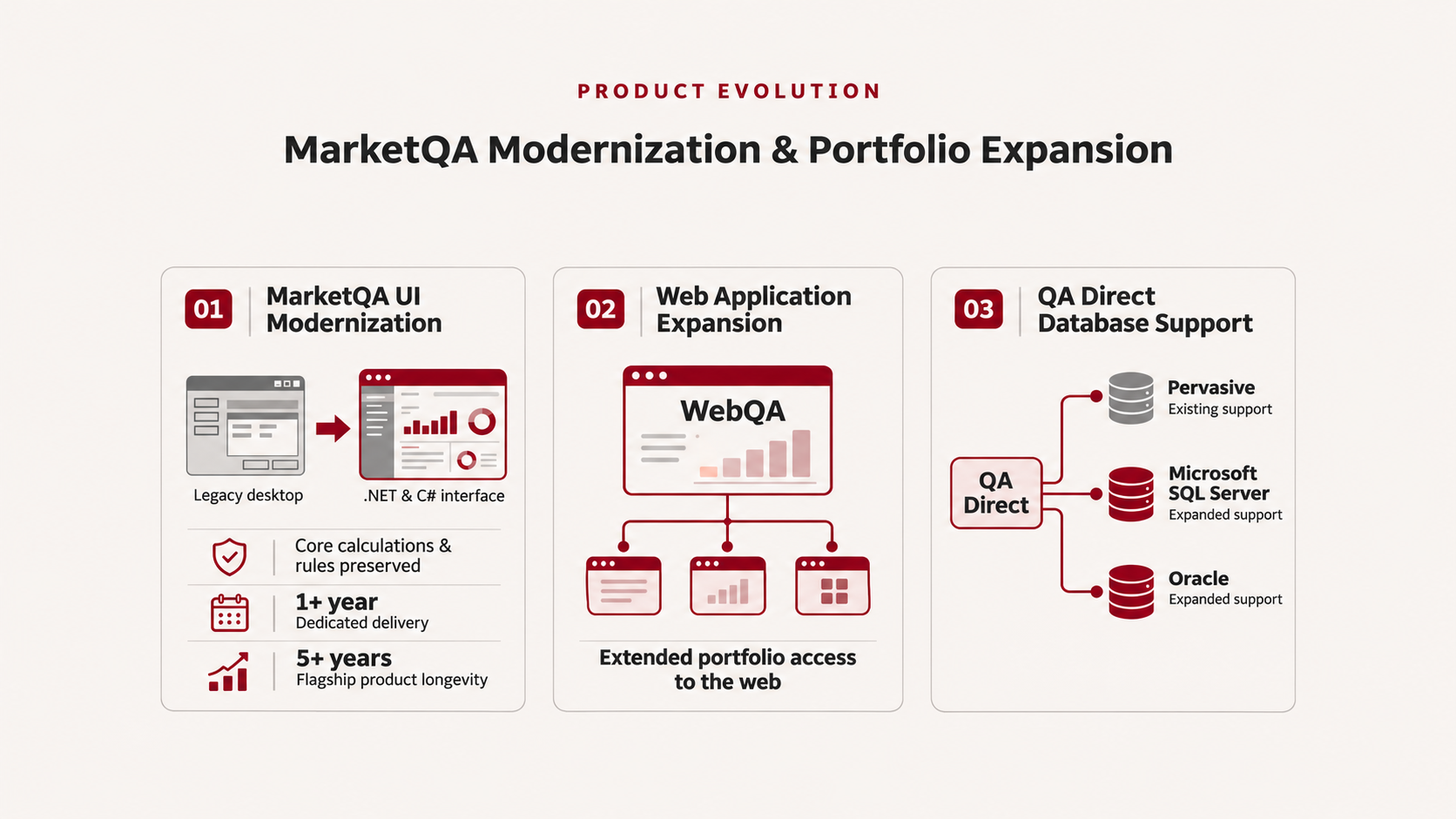
MarketQA modernization. MarketQA was QAI’s financial analytics application for investment research and portfolio analysis. Its user interface needed modernization, but the client faced resource and specialist-skills constraints. SSI ultimately took the lead in delivering an updated interface using Microsoft’s .NET software framework and the C# programming language, while preserving existing features and established calculations and rules.
The project took over a year to complete. The product remained flagship quantitative analytics offering for more than five years after launch, demonstrating the lasting role of the modernized application.
Web applications and database expansion. The engagement included WebQA, a web-based application in the financial analytics portfolio, and QA Direct, a product for accessing financial data through customer databases. Support expanded from the Pervasive database platform to Microsoft SQL Server and Oracle, broadening the database technologies available to customers.
SSI provided parallel teams across development, modernization, QA, data quality, and innovation. These teams operated at the same time rather than in sequence, so ongoing work never had to pause for new initiatives. SSI scaled the delivery organization significantly, reaching roughly 88 people at its peak. That scale was tied directly to business demand rather than a fixed headcount planned in advance.
SSI retained domain and platform knowledge as QAI became part of Thomson Financial and later Thomson Reuters. That continuity meant the organization did not have to rebuild institutional knowledge each time ownership changed. SSI accumulated knowledge across products, data flows, platforms, and business domains. That depth of knowledge is what lets SSI operate as a technology partner rather than a source of individual contributors.
SSI contributed to engineering scale, modernization, new capabilities, and product evolution. SSI entire engagement fed directly into the client’s ability to compete through stronger products and faster development.
The Impact
Across the relationship, SSI’s role expanded from delivery support into a strategic technology partner. The engagement produced:
- Development speed. More configurable data import processes and additional delivery capacity supported the introduction of new feeds and features. This addressed the integration bottleneck that constrained the expansion of market coverage.
- Engineering efficiency. Reusable processes reduced reliance on bespoke integration work. Dedicated teams supported new development alongside maintenance and modernization, drawing on knowledge accumulated throughout the relationship.
- Scale and specialist skills. The team grew to 88+ engineers across multiple products and functions. SSI supplied the capacity and technical expertise needed to take on work such as MarketQA modernization and database expansion.
- Delivery results. The data ingestion project successfully processed historical information dating back to 1969, exceeded performance and quality benchmarks, and met its schedule and budget commitments.
- Product evolution. MarketQA modernization, WebQA development, and QA Direct database support helped the product range evolve across user interfaces, web delivery, and customer database environments.
- Continuity through two acquisitions. SSI retained product and financial data knowledge from QAI through Thomson and Thomson Reuters, supporting an ongoing relationship as the organization changed.
Engagement Snapshot
| Industry | Financial services / Financial technology |
| Client Evolution | QAI → Thomson Financial → Thomson Reuters; broader corporate lineage → Refinitiv → LSEG |
| Relationship Duration | Approximately 10 years |
| SSI Team Scale | Approximately 88 professionals at peak |
| Core Capabilities | • Financial data engineering
• Data ingestion • Data warehousing • Data distribution • Data licensing • Database engineering • Application development • Platform modernization • Web development • Quality engineering • Test automation • Data quality • Product support |
| Strategic Value | • Engineering scale
• Faster product expansion • Financial-data scalability • Technology modernization • Quality and reliability • Knowledge continuity • Adaptability through acquisition • Long-term strategic partnership |